


For all businesses, and small businesses in particular, getting found online is crucial to success. To be found online you need to get to the top of Google, and to do that you need Search Engine Optimisation.
But first, what exactly is it?
What is SEO?
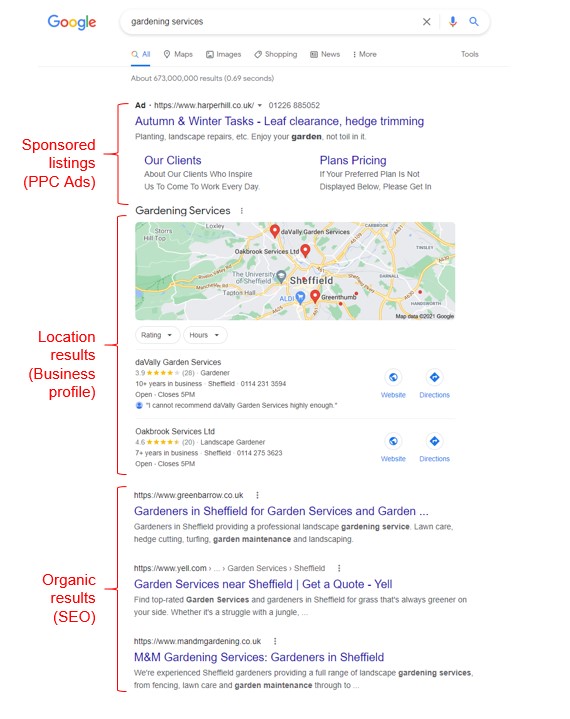
Search engine optimisation is the science and art of affecting the online visibility of a website or a web page in a web search engine’s unpaid results — often referred to as “natural”, “organic”, or “earned” results. Not to be confused with pay per click, which is paid effort to feature in the sponsored listings at the top of the page.
Why should small businesses put time and money into SEO?
SEO remains one of the most cost-effective ways to market to your audience. It’s also measurable, so you can see the impact of your investments.
>See also: A guide to marketing your small business on YouTube
It really needs to be seen as a medium to long-term investment. SEO takes time and continual effort on a monthly basis to achieve your targets but the rewards are huge if you put a strategy in place that delivers results.
For small businesses there are two areas of SEO:
- Organic search means having your company website appear on the first page of the search engine listings, after the paid adverts when a client searches for certain keywords. If you focus on SEO you can expect to see progress here after six to 12 months, if the market is competitive, so think of the first year as an investment. In the second year, it starts to become a sustainable effort
- Location-based marketing is also important, especially if you’re a local business. When you carry out a search you often see a map, with three results linked to that map. That’s almost a little search engine in its own right. Optimising your free Google ‘My Business’ profile will help you to start getting those results when people search for services in the local area
How do search engines determine pages’ relevance?
If you’re looking at a complete list, you can get quite bogged down. There are over 200 ranking factors that search engines take into account when putting pages into a list of results.
Really, at the top level, there are three core areas:
- Content
- Links
- Technical optimisation
These are the fundamentals that anyone optimising a site needs to address. We sometimes see websites that have a lot of content but it’s just not optimised. It’s churned out without any thought or any measurement. A big part of SEO is ensuring all of your content adds value and it’s optimised towards your end user. It’s important to develop a content strategy for your business that speaks to your target audience and helps you to grow.
Links are a vote of confidence for your website or content. Building a strong web of links to your site is a key part of ranking. Managing your link profile and improving it is so important – it’s about quality, not quantity. In the past, dodgy SEO agencies might have gone out and bought you loads of links. Those days are over. You have to achieve and earn your links to gain ranking improvements.
Finally, the technical element is the under the hood stuff; which is how search engines, like Google, see and understand your site. As end-users we look at the content, the words on the page, but that’s only one area. There are lots of technical aspects that can lead to the site improving, the big ones are site speed and making sure the site is optimised for mobile as well as things like structured data, metadata and code to text ratio. These can all have an influence on search rankings.
>See also: Is TikTok better than Facebook for small business ads?
Why are keywords so important for Google?
Keywords are the start point for SEO. Over 90 per cent of online experiences start with a search. You really need to align your website with your customers’ needs and know which keywords they may type into the search engine.
Some companies might think “I’m business to business, so SEO isn’t for me” but there’s a huge shift taking place in B2B. We call it the “consumerisation” of B2B marketing. We already go online, research and compare websites and download case studies for our own daily lives. This experience is moving to businesses as well now.
At The SEO Works we like to talk about “micro-moments” – that moment in time when we act on an intent, search for a word, and expect an immediate answer. It happens all the way along the purchase journey for consumers and B2B. There can be hundreds of micro-moments leading to a purchase or enquiry. As a business you need to think about the micro-moments that are important for your business and how to be there online when they happen. Keyword research is a big part of that.
Where should I start?
Here are three things you can start doing straight away…
Do a Google search for yourself on the internet – If you can’t find your own company website and web pages on Google, what chance will your customers have? How you look on Google search results pages affects whether people click on them. The preview page title and meta description must encourage people to pick your page. Avoid overly long and automatically generated info.
Create amazing digital content around real search terms – The words and phrases your potential customers actually search for on Google may surprise you. Find the real search terms people use – don’t guess. Target long-tailed keywords rather than just generic one-word terms, for example “cheap dog bow ties in London” rather than just “bow ties”. Then make unique, engaging and trustworthy content around those words.
Make yourself easy to find on Google Maps – Do you have a bricks-and-mortar business? If you don’t appear on Google Maps, local customers may second guess your very existence. Set up a Google My Business account and ensure your open hours, telephone number, email address and website are accurate. Customers will also have the chance to write (hopefully positive) reviews about you.
Getting serious about SEO
There are three stages you need to follow to get serious about SEO.
Research
The first stage of taking being found online seriously is learning how your target audience is searching for the product or service you offer. Think about all the stages in that purchase journey, from research to enquiries. Identify the different searches people might use along the way. Often, we see business owners who are very focused on that last part of the journey, where someone has decided which product or service they want and types that product name into Google. You need to think back from that, the search probably starts at a much broader set of keywords.
So if I was looking for a new pair of trainers I might start with “best trainers of 2021” or “the trainers leading athletes use”, or just things like “white trainers”. I might then refine to category searches like “nike”. I may then go even deeper with things like “nike air jordan” or “nike air jordan discount codes”. You can see that my searches are getting more specific as I conduct my research and hone in on the product I want. But if as a brand, you have provided great information at the start of that search journey, I might be more inclined to purchase from you once I was ready to buy.
So, maybe if you’re looking for a service online, you’ll start with general search words which you’ll refine as you do more research. The first point is to do your keyword research and think of the most common searches performed by customers. Have a look – are you there for your searches? Are you happy with what you see? How do you compare with your competitors? Are you there on mobile?
A good place to start this is with Google Keyword planner, or UberSuggest, where you can enter a variety of searches and it will return data on average search volumes in your target market, and also come up with suggestions you might not have thought about.
Strategy
Once you have a picture of where you want to be, you have to think about how you’re going to get there. A lot of that involves creating a strategy of how you’re going to build your website through content, technical aspects and links.
To set a baseline on this, you’ll also need to benchmark where you are. We like to use a red/amber/green status for over 150 different benchmark checks we undertake, which really allows clients to see the wood from the trees and focus on the key changes that will make a difference. A good way to start with this is to undertake a keyword and content gap analysis which identifies where your competitors are strong but you are weak.
Measure
This is a key point that often gets missed or not thought about fully. You need to decide on aims for the website, as different businesses have different goals. Do you want to generate more traffic, do you want more leads, more enquiries, or do you want to get more downloads, more comments, or more online sales? It depends on your business, as to what’s important to you.
Once you have your strategy, make sure you are measuring what matters to you as a business over time, so you can grow and learn. By using Google Analytics, everything is measurable and by practicing this you’ll start to see improvements and ultimately success. There are also lots of keyword tracker tools out there so you can track ranking movements over time.
Paul Friend is head of SEO at The SEO Works
Further reading