


In today’s economy, every company that conducts business internationally is exposed to foreign exchange risk.
Before Brexit and the recession, many businesses were less concerned about the impact currency volatility could have on their bottom line, as currencies could move as little as 5 per cent in a month. Some sectors even employed pricing strategies such as currency buffers to protect against volatility. However, ongoing global economic uncertainty provoked currency volatility that made these buffers ineffective as a protective method.
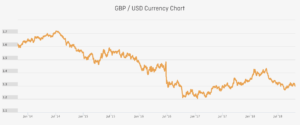
Since the recession and Brexit, the pound has plunged against a basket of currencies, including the Dollar (shown below) and Euro.
Fluctuating exchange rates can greatly alter the cost of trading internationally and many finance directors are investigating more innovative ways of protecting themselves against currency exposure, as well as looking more broadly at their end-to-end international payments process. Some businesses are even starting to think twice about expanding into international markets, because the cost of doing so could potentially outweigh profitability.
The risks inherent in the volatility of the currency markets makes accurate business forecasting very difficult and underlines the importance of currency risk management tools.
In a survey conducted by Travelex Global Business Payments, more than a quarter (29 per cent) of the businesses interviewed make international payments to hundreds of foreign beneficiaries (between 101 and 2,000). Despite the sizeable number of outgoing payments, only a third use currency risk management tools like forward contracts, limit orders and stop loss orders to protect themselves from currency volatility.
What options are there for SMEs when trying to reduce costs and increase profit margins?
Companies that specialise in international money transfers could help businesses save a significant amount on foreign transaction fees. By eliminating inflated exchange rates and receiving fees, money transfer specialist TransferWise is making it up to eight times cheaper than the banks to make international payments. See their currency converter here.
It’s cheaper because they always convert payments using the mid-market exchange rate. All you’ll pay is a small upfront fee on the total value of the transfer. And since it’s regulated by the FCA and used by over 3 million customers, it shouldn’t be a surprise that 80 per cent of payments from GBP to EUR occur within the same working day. Meaning you’ll also save time – and refocus resources on more profitable endeavours.
Forward contracts, a popular currency risk management tool, enables businesses to secure a fixed exchange rate for payments scheduled in the future to protect themselves against currency market volatility. Payment settlement can be a flexible or fixed date and businesses have the option to draw down (pay as you go) on a fixed date or in an agreed time window. The ability to secure the rate helps mitigate the foreign exchange risk, protects the company’s margin, and allows them to predict their cash flow more accurately.
“The ability to fix the rate for up to one year in advance helps businesses to budget and forecast for the year ahead”
With a forward contract, financial directors can better forecast their profit margins and inevitably adds a huge advantage to businesses that have to price goods or make purchases now but are not required to pay for them until some time in the future in a different currency.
GFI Cables is a UK based manufacturer and wholesaler of high quality, bespoke cable and connector solutions for the computing and telecommunications industries. Led by managing director Gary Flynn, the company has been trading since June 2000 and has posted turnover of over £1 million. Flynn comments that at any stage in a business’s life, saving money is likely to be high on the list of priorities, and that this is particularly critical in the early years. ‘Forward contracts have hugely benefited us as I can set payments at the current rate of exchange for up to a year in advance. They are a great benefit for the business,’ he says.
See also: Managing your currency risk when exporting – Information on how small companies can navigate currency exchange risk when trading internationally
Andrew Roberts, chief executive of travel specialist firm Amro Holidays adds, ‘As the business has grown, we increasingly need to manage the currency risk and are now able to do so by using [forward contracts].”
There are other tools available to businesses who wish to protect themselves from adverse currency movements. For example, if a business has a target exchange rate, an international payments specialist will monitor the market for them 24 hours a day – for free – and is particularly useful if a business is happy to wait a little longer to achieve their desired exchange rate. Standing Orders also give peace of mind because the business knows the markets are being monitored, but they do not have to waste their time or human resource. This personalised service is in complete contrast to the service that businesses are offered at their banks. As David Palmer, Director at Tours Designed comments, ‘Using an international payments specialist means that we have reduced our costs and gained a great deal of our most valuable asset – time. We know exactly how much our payments cost, when our account will be debited and when our suppliers will receive the funds.’
Over the last decade, we have witnessed a revolution in retail banking, with consumers using new technologies to make payments in more efficient and accessible ways; contactless payments are just one of the latest innovations to take off. Businesses should be looking to leverage innovative tools like forward contracts that can help to mitigate risk – establishing peace of mind and ultimately, saving them money.
Tips on how to protect your bottom line from currency volatility
- Talk with a specialist before implementing a foreign currency strategy. Foreign exchange products and strategies don’t adhere to a one size fits all approach. A successful strategy needs to suit your individual business needs.
- Get your forecasts in order. Take the time to identify what your business will be spending and when those payments will be made in the coming 12 months. Don’t forget to know your terms of trade.
- Set your budget rates. Identify the baseline profit you need to protect to remain profitable and then target strategies that can help you protect it.
- Don’t overcomplicate your foreign exchange strategy. Make sure your strategy protects the business bottom line without dragging you away from the day to day operations. Make sure you understand your hedging strategy and its impact on your business.
- Be a commercial success not a currency speculator, and never lose sight of your business’ operational and financial objectives. Adopt currency strategies that let the underlying business make your profits rather than relying on currency gains to prop up the bottom line.
- Be careful not to overhedge. It can be prudent to leave a portion of your currency needs unhedged. That way you have some room to move if expected contracts fall through and your business can also benefit from any upswing in exchange rate movements.
Watch the below video on currency forward contracts